
On Danish traditions
The Art of the Danish Reception
How Danish celebration culture — the long table, the singing, the particular relationship between food and time — can be introduced to an international couple's evening in ways that feel meaningful rather than theatrical.
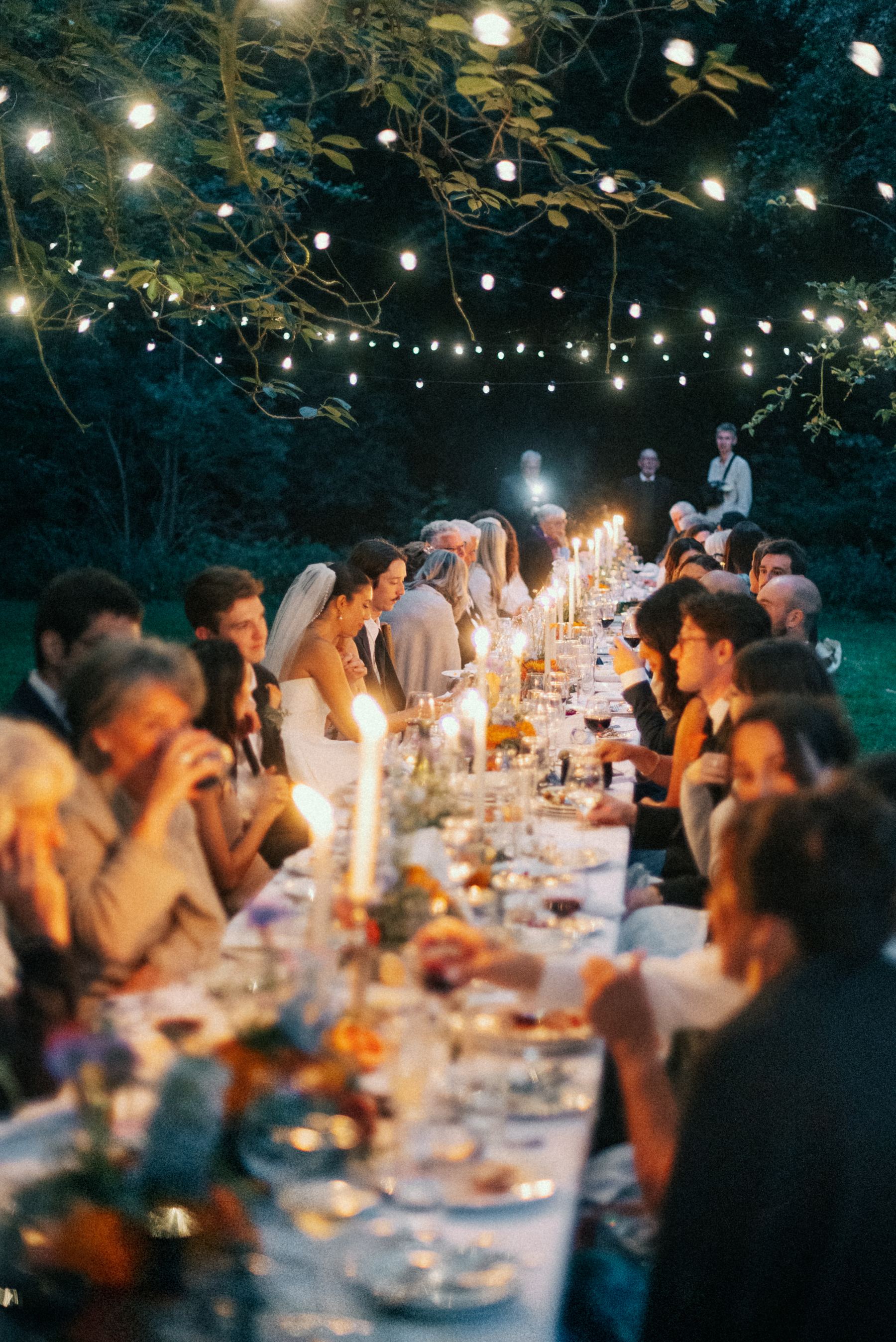
The Danish reception is not an event. It is an institution — a set of rituals so embedded in the culture that most Danes cannot fully articulate them until asked to explain them to someone from elsewhere. I have spent twenty years explaining them, and I am still finding new things to say.
At its core, the Danish reception is organised around one principle: there is no reason to hurry. The evening begins, and then it unfolds. Dinner is not a fixed hour — it is a direction. The speeches are not timed presentations — they are offers of love, in the form of sung verses composed by people who have thought carefully about what they want to say. The dancing, when it comes, is not a scheduled activity. It is the point at which the evening becomes something else entirely.
The table.
The long table is the spatial argument the Danish reception makes about itself. It says: we are all here together, and the purpose of the evening is conversation. Not a room divided into rounds of eight where you speak only to the people on either side of you. One table, or a configuration that feels like one — where the couple can see their guests and their guests can see each other.
The table is set with care: the napkins, the glassware, the small printed menu that tells the guests what they are about to receive. These objects are not decorative. They are signals of attention — evidence that someone has thought about this evening and about the people who will be spending it together.
The songs.
Nothing surprises international guests at a Danish wedding more than the singing. Not the couple’s first dance — the guests’ singing. Danish wedding guests compose verses, set to familiar melodies, and perform them for the couple across the table. The tradition is called bordvise, and it is one of the most intimate things I have encountered in any celebration culture.
For international couples, this requires translation — both linguistic and cultural. We prepare guests in advance, provide lyric sheets in the relevant languages, and work with whoever is composing the verses to ensure they land as intended. When it works, guests who arrived knowing nothing about the tradition often tell us afterwards that it was the moment they will remember longest.
The food as time structure.
In Denmark, the meal is not the prelude to the celebration — it is the celebration. Courses arrive at a pace that is determined by the conversation, not the kitchen schedule. A Danish wedding dinner is rarely under four hours. This is not inefficiency. It is the whole point.
The smørrebrød at a pre-wedding lunch. The cold table. The open kitchen. The rye bread that arrives with actual good butter and is treated with the same respect as the wine. These are not folkloric gestures — they are expressions of a food culture that takes hospitality seriously and understands that what you put in front of a guest is a statement about how much you value their presence.
How to introduce these traditions to an international couple.
The mistake is treating Danish traditions as costume. A folk element dropped into an otherwise conventional wedding programme reads as tourist. What works is integration — understanding which traditions carry genuine meaning for the Danish partner and their family, and finding ways to introduce them that feel organic rather than explained.
Sometimes this means beginning the evening with a Danish cocktail hour and allowing the food to announce itself slowly. Sometimes it means commissioning a single bordvise, translated and sung by one table, as an introduction to the tradition for international guests who will then understand the second one. Sometimes it means simply serving the smørrebrød lunch the day before and letting it do the work of orienting guests who have never been to Denmark.
The result, when we get it right, is a celebration that feels completely itself — not a compromise between two cultures, but a synthesis that honours both.
Private commissions