
France
Getting married in Provence
Provence gives you formality without stiffness — gardens, stone, long lunches and a service culture that takes food seriously. Planning here is about respecting how the region works rather than importing a programme into it.
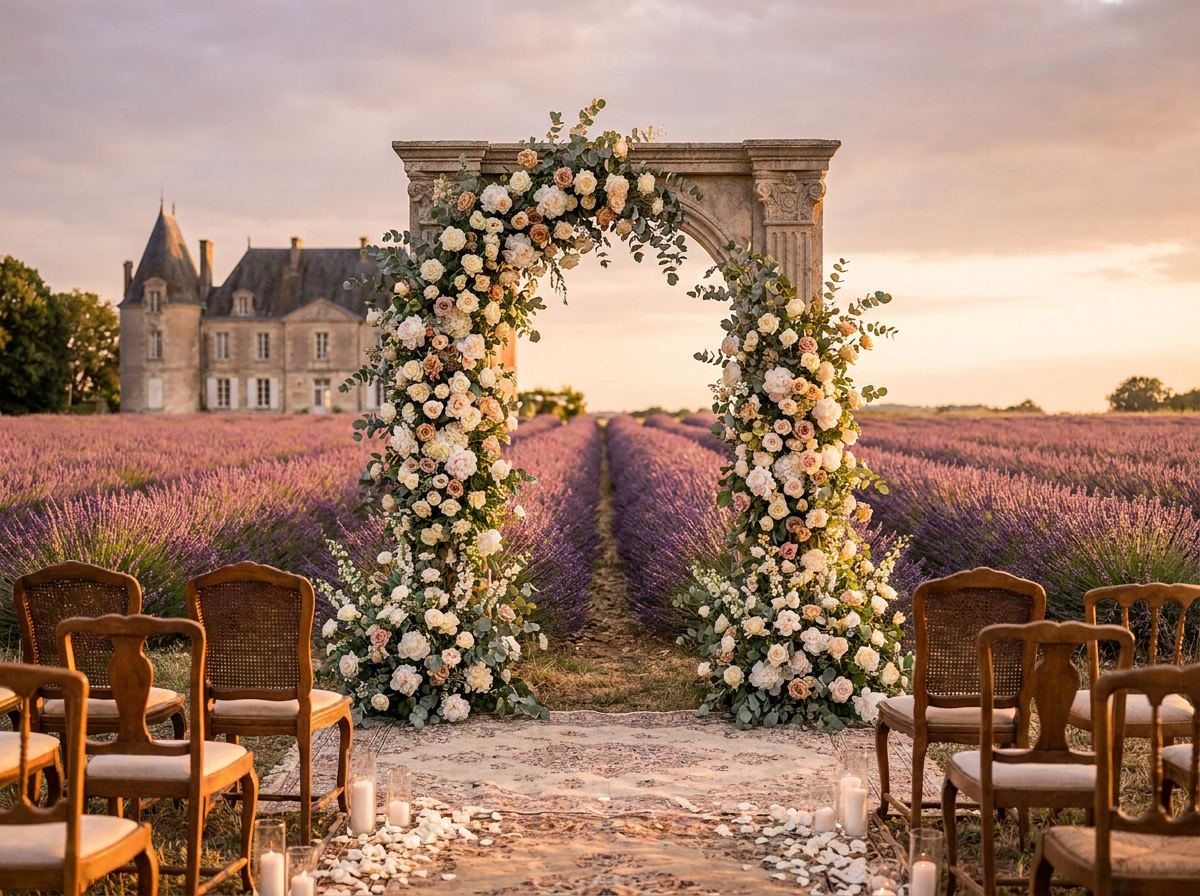
Provence attracts couples who want the south of France without the visibility of the Riviera: plane trees, gravel courtyards, tables under vines, and dinner that is treated as the reason everyone travelled. It is an excellent destination for a two- or three-day celebration, and a demanding one for anyone who assumes it works like Italy or Spain. The venue culture is more private, the legal route is stricter, and the weather has one specific personality.
The venue types
The château
Formal architecture, ordered gardens, salons for dining, and the presence a large guest list needs. Verify what exclusive use includes, whether interiors are available for dinner or only for aperitif, and — on listed properties — what restrictions apply to temporary structures, lighting rigs and open flame.
The domaine or vineyard estate
A working wine estate gives you the region on the plate and in the glass, with cellar rooms that make excellent wet-weather dining. Assess kitchen infrastructure and power honestly: a domaine that hosts tastings is not automatically equipped for a plated dinner for 140.
The mas or bastide
A stone farmhouse, often with accommodation, suited to celebrations of 60 to 120 that want intimacy rather than grandeur. This is where Provence is most itself, and where guest experience over a weekend is easiest to control.
Village and town settings
Ceremonies in Provençal villages can be extraordinary, and add real logistics: restricted vehicle access, limited parking, and neighbours whose evening you are borrowing. Handled properly it is the most charming option on offer.
The French legal requirement
France does not offer a convenient civil marriage for visiting couples. A French civil marriage is performed at the mairie of the commune, and French law requires a genuine residence connection to that commune for one of the parties — a continuous stay of around thirty days before the publication of banns is the standard expectation, with parents’ domicile accepted in some cases. Religious ceremonies in France may only take place after the civil marriage.
The practical consequence is that the overwhelming majority of international couples marrying in Provence complete the legal marriage in their own country and hold the ceremony in France with a celebrant. That ceremony can be held in the garden, bilingual, personal and as ceremonial as you wish. If a legally binding French ceremony is essential, the residency requirement, the commune, and each party’s documentation must be resolved before anything else is booked. Couples who want a legally binding ceremony abroad without a residency burden are often better served by Denmark.
Season, mistral and heat
Late May, June, September and early October are the best windows. July and August bring heat and the full weight of French holiday season — accommodation prices rise, roads and restaurants fill, and afternoon ceremonies need serious shade.
The mistral is the regional variable worth understanding: a strong, dry north-westerly that can blow for days, most often in spring. It affects tall floral installations, candles, marquees, sound and hair. Design for it rather than hoping — anchored structures, wind-tolerant floral, protected candlelight, and a real alternative for an exposed ceremony site.
Food, wine and the shape of the day
French service is slower and more structured than Anglo-American timelines assume, and the meal is the centre of the evening. Aperitif is generous, courses are properly spaced, and the cheese arrives when it arrives. Build the programme with the kitchen, not around it: speeches distributed between courses, and the band starting when dinner genuinely finishes. Traiteur and château catering arrangements vary — some estates impose an approved supplier list — so confirm catering freedom before you fall in love with a venue.
Guests, transfers and curfews
Most guests arrive through Marseille or Nice, with the TGV a strong alternative from Paris. Accommodation is typically distributed across several hotels and rented houses, which makes transfers and clear information essential: staged coach departures, a late final return, and a single source of truth for timings.
Rural French communes apply noise regulation, and many estates hold licence terms that end amplified outdoor music by midnight or 01:00. Ask for those terms in writing and plan the evening’s second half accordingly.
What the money goes on
Venue hire, catering and wine, production hire, floral volume, staffing, transfers, and — on properties without event infrastructure — temporary kitchen, generator and quality guest facilities. Listed properties can add cost through restrictions on rigging, flame and structures. French quotations may exclude TVA and service; we standardise every figure gross, with contingency, so the number you approve is the number you pay.
How we work here
Christel Winther has planned and produced weddings since 2002 and takes on a limited number of commissions each year, each personally led, supported by a small, experienced production team. In Provence that means venue research and site visits, supplier assessment and negotiation, ceremony and legal guidance for international couples, guest travel and transfer logistics, programme design across several days, budget accountability, and direction on the day.
See Provence for the destination, and the approach for how a commission is planned.
Questions
Frequently asked
Can we legally marry in Provence as foreigners?
Only with a genuine residence connection to the commune — French law expects around thirty days' continuous residence for one party before the banns are published, and religious ceremonies may only follow the civil marriage. Most international couples marry legally at home and hold a celebrant ceremony in Provence.
What is the best month?
Late May, June, September and early October. July and August are hot and coincide with French holiday season, which affects prices, availability and guest comfort.
What is the mistral and does it matter?
A strong dry north-westerly wind, most common in spring, that can blow for several days. It matters for tall floral, candles, marquees and sound. It is manageable when the design anticipates it and there is a genuine alternative ceremony location.
Can we bring our own caterer?
Sometimes. Many châteaux and domaines work with an approved traiteur list, and some require their own kitchen. Confirm catering freedom before committing to a venue, because it shapes both the menu and the budget.
Related
Private commissions