
Italy
Getting married in Tuscany
Tuscany is the most requested wedding region in Europe, and the most misunderstood. What follows is how the work is actually done — the venue types, the legal route for foreign couples, the season, and the cost structure behind the photographs.

Almost every couple who considers Tuscany arrives with the same image: a long table under cypress trees, the hills falling away in every direction, dinner that lasts until it is properly dark. That image is achievable. What it requires is less romantic than it looks — a venue chosen for its infrastructure as much as its view, a realistic understanding of Italian catering culture, and a legal route agreed early rather than assumed.
The four Tuscan venue types
The historic villa
Renaissance and later villas — often in the hills around Florence, Siena or Lucca — offer formal rooms, terraced gardens and limonaias that make excellent wet-weather ceremony or dining spaces. They are usually the strongest option for a guest count between 80 and 200, because they were built to receive people. Verify whether the villa is licensed for civil ceremonies, whether the interiors are usable for dining or only for drinks, and whether any rooms are off limits as private residence or museum space.
The working estate or agriturismo
A wine or olive estate produces the version of Tuscany most couples describe: informal, agricultural, generous. Guest accommodation is often on site, which transforms the weekend. The trade-off is infrastructure — kitchens sized for a restaurant rather than a banquet, and power supply that a full production will exceed. Ask for the amperage available, and whether a generator has been used at previous events of your size.
The hamlet or borgo
A restored village taken over exclusively is the most complete option for a multi-day celebration: several courtyards, a chapel, a pool, and enough beds to hold the core group for three nights. It also demands the most programming. If nobody designs the days between the arrival dinner and the wedding, guests will design them badly.
The city venue
Florence and Siena both offer palazzi and civic rooms with a formality the countryside cannot reproduce. Consider heat, guest transfers, and restricted-traffic zones for supplier vehicles before committing to a city ceremony followed by a countryside dinner — that combination is beautiful and logistically expensive.
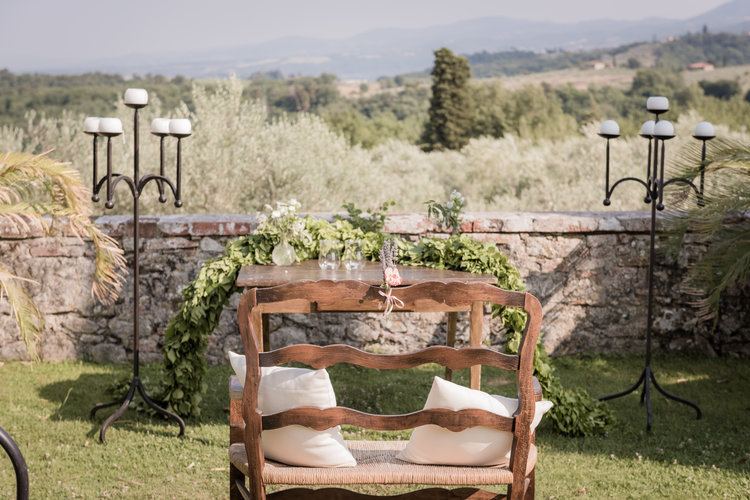
Marrying legally in Italy as a foreign couple
Italy is one of the more accessible European countries for foreign couples who want their marriage to be legally performed on site rather than at home. A civil ceremony is conducted by an officer of the local comune, either in the town hall or in a venue the comune has licensed for the purpose. Requirements are set nationally but administered locally, and the local interpretation matters — which is why the venue and the comune should be confirmed together, not separately.
In outline, non-Italian couples produce a sworn declaration of no impediment to marriage — obtained through their own country’s embassy or consulate in Italy, or through the process their nationality requires — together with valid passports, birth documentation and, where relevant, evidence of the end of a previous marriage. Documents issued abroad usually require legalisation or an apostille and a sworn translation into Italian. Catholic ceremonies follow a separate church process arranged through the couple’s own parish and the Italian diocese, and are civilly recognised.
Two practical points decide whether this is straightforward. First, timing: consular appointments and document legalisation are the slow steps, and they cannot be compressed. Second, nationality: what a Danish, American, British or Indian passport holder must produce differs, and the requirements for each party are assessed separately. Confirm the exact list with the relevant consulate before booking flights around a date. Where the paperwork is genuinely impractical, the alternative is a legal marriage at home and a full ceremony in Tuscany led by a celebrant — which is what a significant share of international couples in Italy choose.
Season, heat and light
May, June, September and early October are the strong months. July and August bring real heat — an afternoon ceremony in full sun in August is uncomfortable for guests and unkind to older relatives — and August is also when much of Italy closes for holidays, which affects supplier availability.
The single most useful piece of planning in Tuscany is building the day around the light. Sunset determines everything: the ceremony hour, when aperitivo becomes dinner, and when the photographs you actually want are possible. Late-June sunset is roughly two hours later than late-September sunset, so a programme designed for one month does not transfer to the other.
What the money goes on
Venue hire is rarely the largest line. For a countryside celebration the costs that grow are catering and beverage, floral and décor volume, production hire (tables, chairs, glassware, linen, lighting, sound, marquee or shade structures), guest transport, and staffing. On an estate without full event infrastructure, temporary kitchen, generator, and quality guest facilities are additions rather than options.
Three decisions move the total more than any others: guest count, the number of days you programme, and whether the site can support your plan without temporary infrastructure. A villa with a licensed ceremony space, a professional kitchen, adequate power and covered dining is materially cheaper to produce than a spectacular field with a view, even when the field is free.
Italian suppliers commonly quote net of IVA, and service and transport are frequently separate lines. A budget that does not state which figures are gross will drift. We build every commission budget gross, with contingency, from the beginning.
Food is the centre of the day
In Tuscany the meal is not a segment of the programme; it is the programme. Long aperitivo, multiple courses, wine from the estate or the region, and a rhythm that is slower than couples expect. Plan the timeline around that rather than against it: a first dance scheduled at the hour Italian dinner service is genuinely finishing will slip, and a schedule that fights the kitchen produces a rushed meal and a tired room.
Guest movement
Tuscan roads are narrow, unlit and often gravel for the last kilometre. Guests who self-drive after a long dinner are a safety problem and a licensing problem. Coach and minibus transfers on a published schedule, with a late return, are standard for any celebration outside walking distance of the accommodation. Confirm that access roads take the vehicle size before the contract is signed, not on set-up day.
What we do in Tuscany
Christel Winther has planned and produced weddings since 2002, and takes on a limited number of celebrations each year. Every commission is personally led by her, supported by a small, experienced production team. In Tuscany that means venue research and site visits, supplier assessment and negotiation in country, legal and ceremony guidance for international couples, guest travel and transfer logistics, budget accountability, and direction on the day itself.
See Tuscany for celebrations we have produced there, and the approach for how a commission is planned from the first conversation.
Questions
Frequently asked
How far ahead should we book a Tuscan wedding?
For a peak-season date at a sought-after villa, twelve to eighteen months is realistic; the venue and the accommodation block are the constraints, not the suppliers. If your guest group needs to travel and stay together, the beds decide the date.
Can we legally marry in Tuscany, or only hold a ceremony?
Both are possible. A civil marriage performed by the local comune is legally binding, and Catholic ceremonies are civilly recognised. The paperwork depends on each party's nationality and needs consular steps that take time. Many international couples instead marry legally at home and hold a full celebrant ceremony in Tuscany — the day looks identical either way.
Which month is best?
May, June, September and early October. July and August are hot enough to affect guest comfort and outdoor timings, and August also reduces supplier availability.
Do we need a planner if the villa has a coordinator?
A venue coordinator represents the venue and works within its terms. A planner represents you across every supplier, country and contract, and is accountable for the whole picture — creative, operational and financial. On a destination wedding, that difference is the reason the day runs.
Private commissions